ReliaSim Sequence

Six steps from production graph
to confident decisions

Your historian shows what happened. ReliaSim shows what will happen—revealing the leverage points traditional analysis systematically misses.

Validated within 1% OEE accuracy — Tom Lange, 36 years P&G

🏭 Built for high-speed manufacturing
📐 Competing risk framework
Within 1% OEE accuracy
15-minute model construction
🎯 Plant manager–operable
The Six-Step Sequence

A structured path to production intelligence

Each step builds on the last. Skip one, and your predictions lose their foundation.

Step One

Draw your production graph

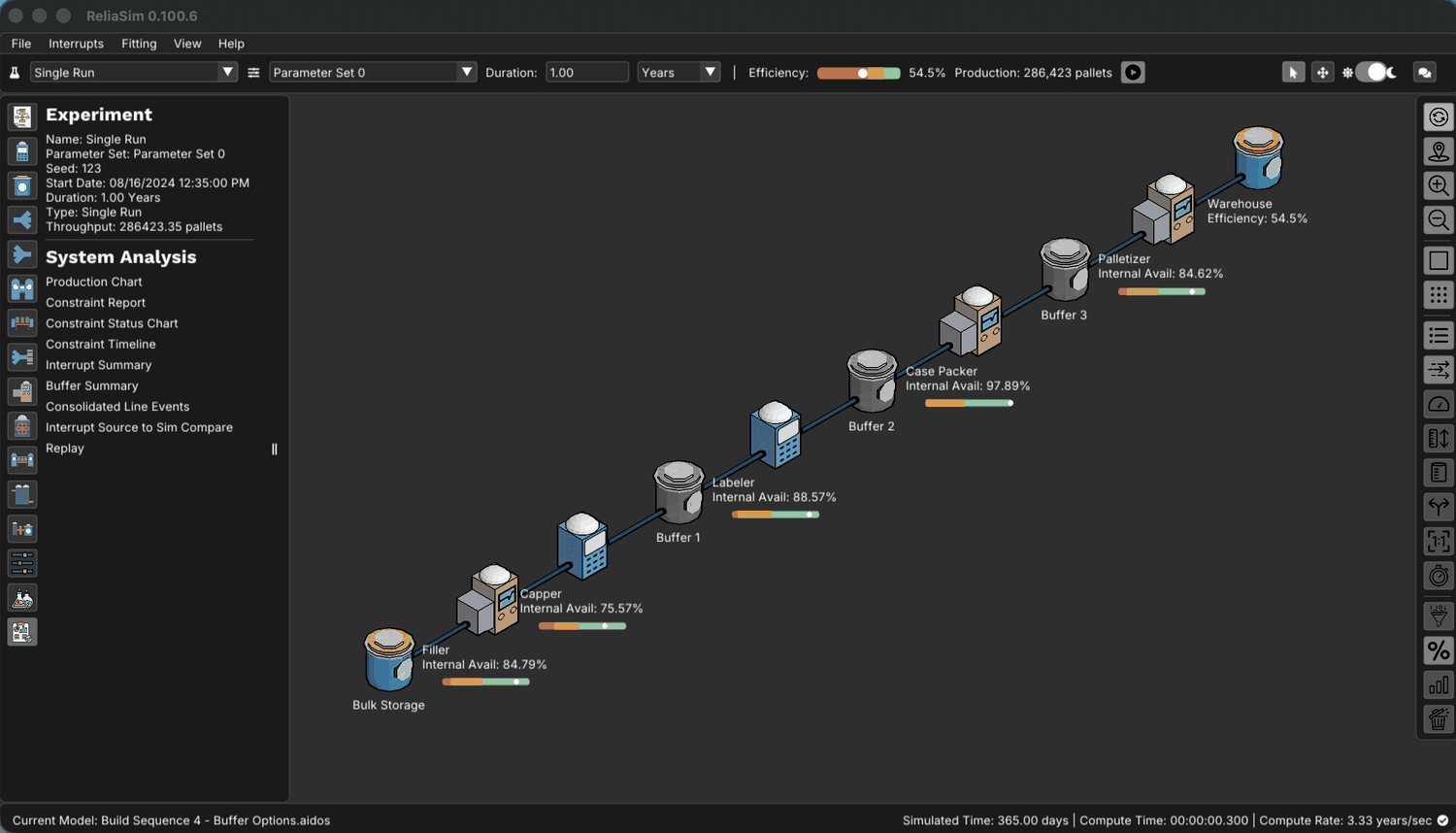
Capture the physical reality of your line—scope, precedence, rates, and conversion ratios—in a single model. This is the structural skeleton everything else depends on.

  • Define every unit operation and the flow between them
  • Set nominal production rates and conversion ratios at each node
  • Establish precedence: what feeds what, what starves what
  • Mark buffer positions and their capacities
so that it captures scope, precedence, rates, and conversion ratios
Step Two

Design your production interrupts

A graph without failure behavior is just a flowchart. Production interrupts are where the system's true statistical character lives—and where traditional analysis goes wrong by treating each event as independent.

  • Assign uptime and downtime distributions to each unit operation
  • Select clock types: age-based, calendar-based, or use-based
  • Set restart and recovery probabilities for nuanced stop behavior
  • Parameterize with ReliaStats for statistically validated inputs
so that it captures production line stops with high fidelity
Step Three

Simulate your baseline model

Run your model as-is, with no changes. Watch how production behaves through time—where flow stalls, where buffers empty, where throughput is lost before it ever appears in your Loss Tree.

  • Observe buffer levels rising and falling through the shift
  • Identify primary and secondary bottlenecks as they emerge
  • See cascade effects: how a jam at one station affects three others
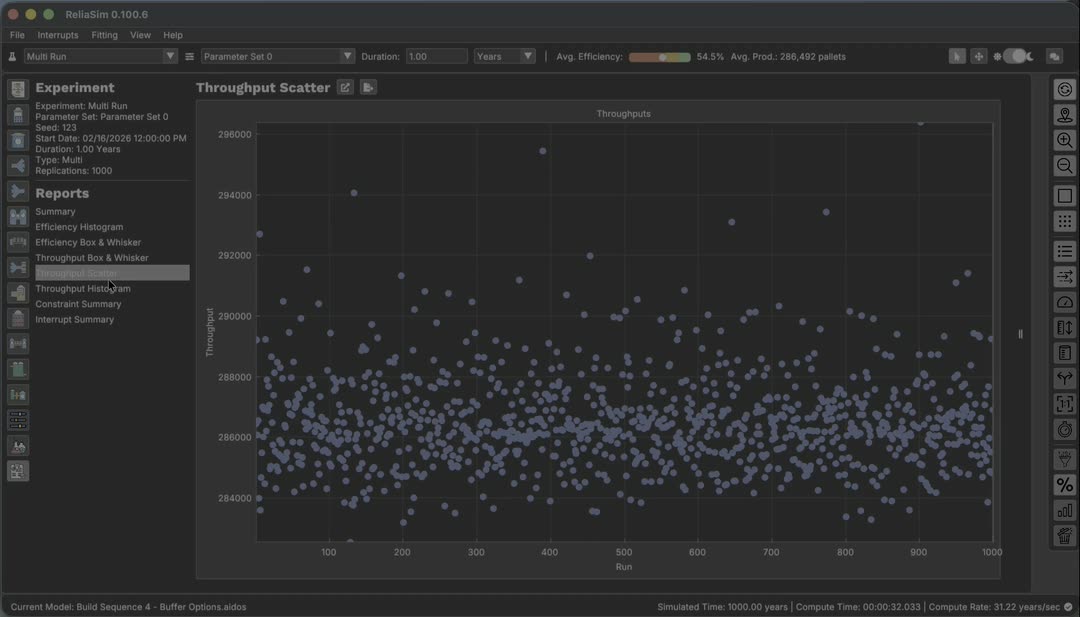
  • Generate OEE and throughput distributions across replications
so that you can see production behavior through time
Step Four

Validate your baseline model

Simulation is only as valuable as its credibility. Validation closes the gap between model output and historical reality—giving you the confidence to act on predictions rather than hedge against them.

  • Compare predicted OEE to historian data within ±1% accuracy
  • Verify that stop frequencies and durations match operational records
  • Tune distribution parameters with ReliaStats when gaps appear
  • Lock the validated baseline as the reference for all experiments
so that you can make confident predictions
Step Five

Experiment with your model

This is where traditional analysis fails and ReliaSim shines. With a validated model, you can test changes before spending a dollar—and discover that your true leverage points are rarely where your Loss Tree says they are.

  • Eliminate failure modes and measure full-system impact, not just direct downtime
  • Compare buffer expansion vs. equipment upgrade on equal statistical footing
  • Test speed trade-offs: sometimes running slower produces more
  • Rank projects by validated OEE gain, not spreadsheet estimates
so that you can know your true leverage points
Step Six

Make confident decisions

The sequence ends where the business begins. Armed with validated predictions and ranked experiments, you move from strategic uncertainty to strategic intelligence—committing capital where the model says it belongs.

  • Present improvement projects with within 1% validated ROI projections
  • Defend capital requests with simulation data, not intuition
  • Prioritize the counterintuitive wins your Loss Tree would have buried
  • Update the model as conditions change and keep your intelligence current
so that you can act with confidence, not hope
Why the Sequence Matters

Traditional analysis explains the past.
This sequence predicts the future.

Manufacturing systems exhibit emergent behavior—cascade effects that never appear under the original problem's name in your Loss Tree. The sequence is designed to surface them.

"Eliminating 120 one-minute problems recovers 220 minutes—because you're changing how the entire system operates under stress, not just removing 120 minutes of direct downtime."
— The 120-Minute Paradox, ReliaSim core methodology
📊

Your historian is explanatory, not predictive

Loss Trees record what happened as independent events. Competing risk modeling reveals they're statistically interdependent—the jam at 10:23 was precipitated by system stress from prior interruptions.

🔗

Sequence integrity matters

A model you experiment on before validation is a model you can't trust. The sequence enforces the discipline that separates confident investment from costly guesswork.

🎯

Leverage points are rarely obvious

Fortune 500 manufacturers consistently find that frequent small interruptions deliver 3× more improvement than the headline bottleneck—because of how they stress the entire competing risk system.

What the Sequence Delivers

From uncertainty to validated intelligence

The six-step sequence is how Fortune 500 manufacturers validate capital decisions before committing.

~1%
OEE Accuracy
Validated baseline models match historian data within 1%—the standard that makes predictions credible enough to act on.
15 min
Model Construction
Plant managers build and run scenarios in real time during strategy meetings—no simulation expertise required.
Typical ROI Multiplier
Projects ranked by simulation consistently outperform Loss Tree priorities—because cascade effects are finally visible.
Get Started

Ready to follow the sequence?

ReliaSim gives plant managers the tools to run every step—from production graph to confident decision—without needing a simulation expert in the room.

Request a Guided Trial Parameterize with ReliaStats